
Relational databases are one of the most widely used and trusted data storage systems in the tech industry. From small websites to enterprise-level applications, relational databases power countless systems where accuracy, consistency, and structured data management are essential. If you’re learning databases, understanding relational databases is a must before moving on to advanced concepts like NoSQL or distributed systems.
Table of Contents
What Is a Relational Database?
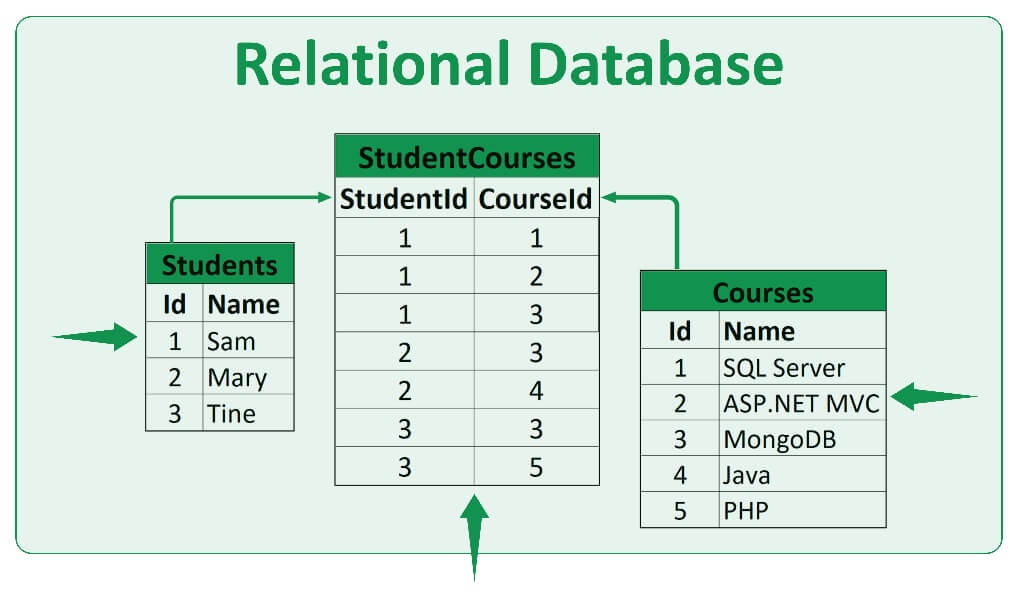
A relational database is a type of database that stores data in tables (also called relations). Each table consists of rows (records) and columns (fields). Every row represents a single entry, while each column defines a specific attribute of that data.
For example, a Users table may include columns like UserID, Name, Email, and Password. Each user’s information is stored as a separate row, making data easy to organize, search, and manage.
Relational databases follow a predefined schema, meaning the structure of tables is defined before inserting data. This structure ensures data consistency and reduces errors.
Role of SQL in Relational Databases
Relational databases are managed using Structured Query Language (SQL). SQL allows developers and database administrators to interact with the database by performing operations such as inserting, updating, deleting, and retrieving data.
Common SQL operations include:
SELECT– Retrieve dataINSERT– Add new recordsUPDATE– Modify existing dataDELETE– Remove records
Popular relational database systems like MySQL, PostgreSQL, Microsoft SQL Server, and Oracle Database rely heavily on SQL for database interaction.
Key Components of Relational Databases
Understanding the core components helps clarify how relational databases function internally.
Tables
Tables are the building blocks of relational databases. Each table stores data about a specific entity, such as users, products, or orders.
Primary Keys
A primary key is a unique identifier for each record in a table. It ensures that no two rows have the same identity. For example, a UserID column is commonly used as a primary key.
Foreign Keys
Foreign keys are used to create relationships between tables. They reference the primary key of another table, allowing databases to link related data efficiently.
Relationships
Relational databases support different types of relationships:
- One-to-One
- One-to-Many
- Many-to-Many
These relationships help maintain structured and meaningful connections between data entities.
ACID Properties Explained
One of the biggest strengths of relational databases is their support for ACID properties, which ensure reliable transactions.
- Atomicity – A transaction is completed fully or not at all
- Consistency – Data remains valid before and after a transaction
- Isolation – Transactions do not interfere with each other
- Durability – Data remains saved even after system failures
These properties make relational databases ideal for financial systems, banking applications, and enterprise software where data accuracy is critical.
Advantages of Relational Databases
Relational databases offer several benefits that keep them relevant even in modern architectures.
- Strong data consistency
- Easy to understand table-based structure
- Powerful querying using SQL
- Mature ecosystem and community support
- Robust security and access control
Because of these advantages, relational databases are often the first choice for applications dealing with structured and transactional data.
Limitations of Relational Databases
Despite their strengths, relational databases are not perfect for every use case.
- Schema changes can be complex
- Scaling horizontally can be challenging
- Less flexible for unstructured data
- Performance may degrade with extremely large datasets
These limitations have led to the rise of NoSQL databases, especially for big data and real-time applications.
When Should You Use a Relational Database?
Relational databases are best suited for:
- Banking and financial systems
- E-commerce platforms
- Enterprise resource planning (ERP) systems
- Content management systems
- Applications requiring complex queries and joins
If your application demands strong consistency and structured relationships, relational databases are a solid choice.
Relational Databases in Modern Development
Even in 2026, relational databases remain highly relevant. Modern tools and cloud services like Amazon RDS and Azure SQL Database make it easier than ever to deploy and manage SQL databases at scale.
Many developers now combine relational databases with NoSQL systems in hybrid architectures, using each where it performs best.
Conclusion
Relational databases form the foundation of traditional data storage systems and continue to be a vital part of modern software development. Their structured design, strong consistency, and powerful SQL querying make them ideal for applications where data integrity is non-negotiable.
For beginners, mastering relational databases is a critical step toward becoming a backend developer, database administrator, or software engineer. Once you understand how SQL databases work, transitioning to advanced database technologies becomes much easier.
Also Check What is a Database – Powerful Guide – 2026
1 thought on “Relational Databases – How SQL Databases Work – 2026”