
Designing an efficient database is not just about storing data; it’s about storing it correctly. One of the most important concepts in database design is database normalization. Normalization helps reduce data redundancy, improves data integrity, and ensures your database remains scalable and easy to maintain as your application grows.
Whether you are a beginner learning databases or a developer working on real-world systems, understanding normalization is essential.
Table of Contents
What Is Database Normalization?
Database normalization is the process of organizing data in a relational database to minimize duplication and eliminate anomalies. It involves dividing large tables into smaller, more manageable ones and establishing relationships between them using keys.
The main goal of normalization is to ensure that each piece of data is stored only once and updated in a single place.
Why Is Normalization Important?
Without normalization, databases can quickly become inconsistent and difficult to manage. When the same data appears in multiple places, updating it becomes risky and error-prone.
Normalization helps by:
- Reducing data redundancy
- Improving data consistency
- Making databases easier to maintain
- Enhancing query performance
- Preventing update, insert, and delete anomalies
Modern relational databases like MySQL and PostgreSQL strongly encourage normalized database designs.
Understanding Database Anomalies
Before diving into normal forms, it’s important to understand common database problems.
Update Anomaly
An update anomaly occurs when the same data must be updated in multiple rows. Missing even one update can cause inconsistencies.
Insertion Anomaly
An insertion anomaly happens when you cannot insert data into a table without adding unrelated data.
Deletion Anomaly
A deletion anomaly occurs when deleting one piece of data unintentionally removes important related data.
Normalization eliminates these issues.
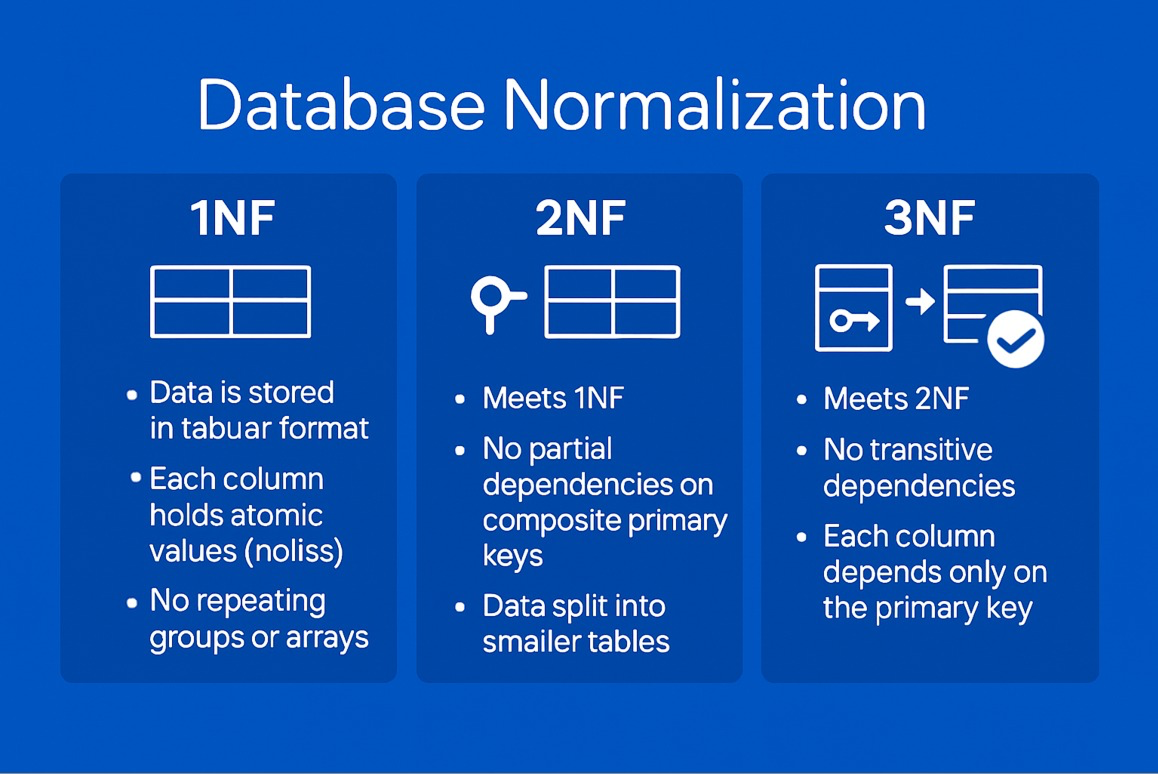
First Normal Form (1NF)
A table is in First Normal Form (1NF) when:
- Each column contains atomic values
- There are no repeating groups or multi-valued attributes
For example, instead of storing multiple phone numbers in one column, each phone number should be stored in a separate row.
1NF ensures that data remains structured and easy to query.
Second Normal Form (2NF)
A table is in Second Normal Form (2NF) if:
- It is already in 1NF
- All non-key attributes depend on the entire primary key
This form mainly applies to tables with composite primary keys. Partial dependencies are removed by splitting data into separate tables.
2NF improves data integrity and makes queries more reliable.
Third Normal Form (3NF)
A table is in Third Normal Form (3NF) when:
- It is in 2NF
- There are no transitive dependencies
This means non-key attributes should not depend on other non-key attributes.
3NF is widely used in real-world database systems because it strikes a balance between performance and data integrity.
Higher Normal Forms
Beyond 3NF, there are additional forms such as:
- Boyce-Codd Normal Form (BCNF)
- Fourth Normal Form (4NF)
- Fifth Normal Form (5NF)
These are used in specialized cases where databases handle highly complex relationships.
Normalization vs Performance
While normalization improves data integrity, excessive normalization can sometimes affect performance due to complex joins.
In practice, developers often use a mix of normalization and controlled denormalization for performance optimization. Database experts recommend balancing both approaches, as discussed in Microsoft SQL Server documentation.
Real-World Example of Database Normalization
Consider an e-commerce system storing user and order data. Instead of repeating user details for every order, normalization separates data into:
- Users table
- Orders table
- Products table
These tables are connected using foreign keys, making the database efficient and scalable.
Tools That Support Normalized Design
Modern DBMS tools offer built-in support for normalized database structures. Platforms like Oracle Database and Azure SQL Database provide indexing and query optimization to handle normalized schemas efficiently.
When Should You Normalize Your Database?
Normalization is best used when:
- Data consistency is critical
- The database will grow over time
- Multiple users or systems access the same data
It is especially important in banking systems, healthcare applications, and enterprise software.
Conclusion
Database normalization is a foundational concept that every developer should understand. It ensures clean data design, prevents anomalies, and supports scalable applications. By applying normal forms correctly, you create databases that are reliable, maintainable, and future-proof.
While performance considerations may sometimes require denormalization, starting with a normalized design is always a best practice. Mastering normalization prepares you for advanced database design and real-world system architecture.
Also Check Best Database Management Systems (DBMS) to Learn – 2026
1 thought on “Database Normalization – Comprehensive Guide – 2026”